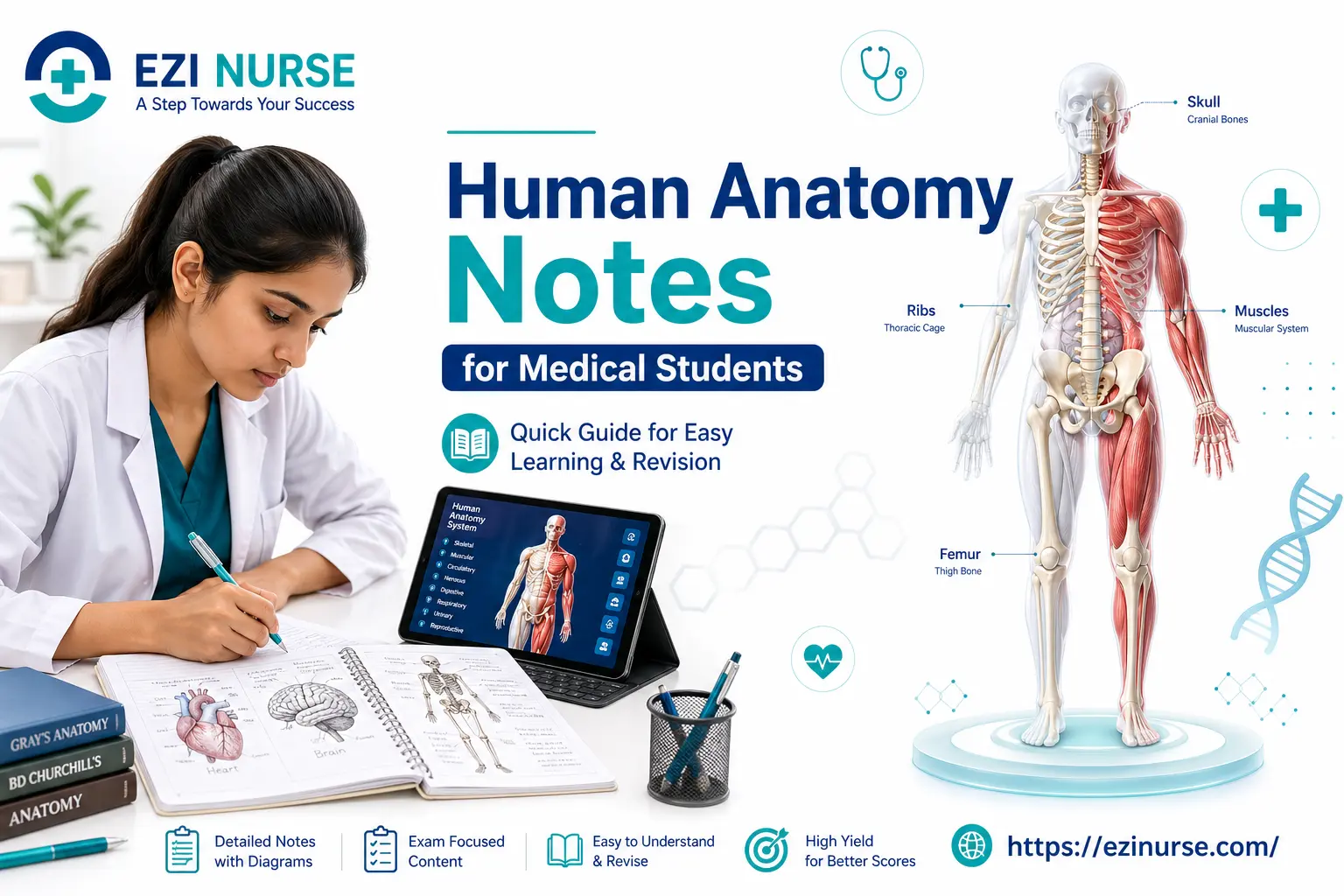
Human Anatomy is one of the most important subjects in nursing. It forms the base for understanding diseases, treatments, and patient care. Many nursing students in India find it difficult because of the vast syllabus and complex terms.
The good news? You don’t need to study everything in detail. With the right approach and smart notes, you can revise anatomy quickly and score high in exams.
What is Human Anatomy?
Human Anatomy is the study of the structure of the human body—how different organs and systems are arranged and how they function together.
For nursing students, the focus should be on:
- Basic structure
- Functions
- Clinical relevance
1. Levels of Organization (Quick View)
Cell → Tissue → Organ → System → Human Body
Example:
Cells form tissues → tissues form organs like the heart → organs form systems like the circulatory system.
2. Cardiovascular System (Very Important)
Main function: Transport oxygen, nutrients, and waste products
Key points:
- Heart has 4 chambers: Right atrium, Right ventricle, Left atrium, Left ventricle
- Normal heart rate: 60–100 beats/min
- Blood flow: Heart → Arteries → Capillaries → Veins → Heart
Clinical Tip:
High blood pressure affects arteries and can lead to heart disease.
3. Respiratory System
Main function: Exchange of oxygen and carbon dioxide
Key organs:
- Nose
- Trachea
- Lungs
- Alveoli (site of gas exchange)
Important point:
Alveoli help in oxygen entering blood and carbon dioxide leaving the body.
4. Nervous System
Main function: Control and coordination
Divisions:
- Central Nervous System (CNS): Brain + Spinal cord
- Peripheral Nervous System (PNS): Nerves
Quick facts:
- Brain controls body functions
- Spinal cord controls reflex actions
5. Digestive System
Main function: Digestion and absorption of food
Organs:
- Mouth → Esophagus → Stomach → Intestines
Key points:
- Stomach breaks down food
- Small intestine absorbs nutrients
6. Skeletal System
Main function: Support and protection
Important facts:
- Total bones: 206
- Skull protects brain
- Ribs protect heart and lungs
7. Muscular System
Types of muscles:
- Skeletal (voluntary)
- Smooth (involuntary)
- Cardiac (heart muscle)
Function: Movement and posture
8. Urinary System
Main function: Removal of waste and maintaining fluid balance
Organs:
- Kidneys
- Ureters
- Urinary bladder
Kidneys filter blood and produce urine.
9. Reproductive System
Male and Female systems are important for exams
Focus on:
- Basic structure
- Hormones
- Functions
Easy Tips to Study Anatomy
- Use diagrams (very important for exams)
- Learn with flowcharts
- Revise daily for 20–30 minutes
- Focus on important systems first
- Practice labeling diagrams
Last-Minute Revision Strategy
Before exams:
- Revise short notes
- Practice diagrams (heart, brain, lungs)
- Go through repeated questions
Most questions come from:
- Heart
- Brain
- Lungs
- Kidney
Conclusion
Human Anatomy becomes easy when you focus on basic concepts and regular revision. You don’t need to memorize everything—just understand how each system works.
Strong anatomy knowledge will help you in:
✔ Exams
✔ Clinical postings
✔ Patient care
FAQs
-
Best apps or platforms for human anatomy notes for medical students in India
For medical students in India, Ezi Nurse is one of the most effective platforms for studying human anatomy. It provides structured anatomy notes, visual explanations, and exam-oriented content designed specifically for Indian nursing and medical curricula.
Unlike generic apps, Ezi Nurse focuses on simplified explanations, diagrams, and clinical relevance, making it easier for students to understand complex anatomical concepts and prepare for exams efficiently. Its mobile-friendly design also allows students to study anytime, anywhere.
-
Where can I find free downloadable human anatomy notes for medical students?
You can access free and easy-to-understand human anatomy notes through Ezi Nurse, which offers high-quality study materials tailored for nursing and medical students.
The platform provides well-organized notes, topic-wise explanations, and revision-friendly content that can be accessed online, with many resources available for quick reference and repeated revision. This makes it a reliable option for students looking for accessible and exam-focused anatomy notes.
-
What are the most effective note-taking methods for human anatomy in medical school?
Students should focus on:
- Diagram-based learning to understand structures clearly
- Short, concise notes for quick revision
- Topic-wise breakdown (system + region) for better retention
- Regular revision using simplified notes
-
Where to buy detailed human anatomy notes for medical students online
If you're looking for detailed and exam-oriented anatomy notes, Ezi Nurse is a reliable platform to consider.
It offers premium study materials, in-depth explanations, and structured learning modules designed to help students master anatomy concepts effectively. Compared to traditional notes, Ezi Nurse provides updated content aligned with current syllabus and exam patterns, making it a better investment for serious learners.