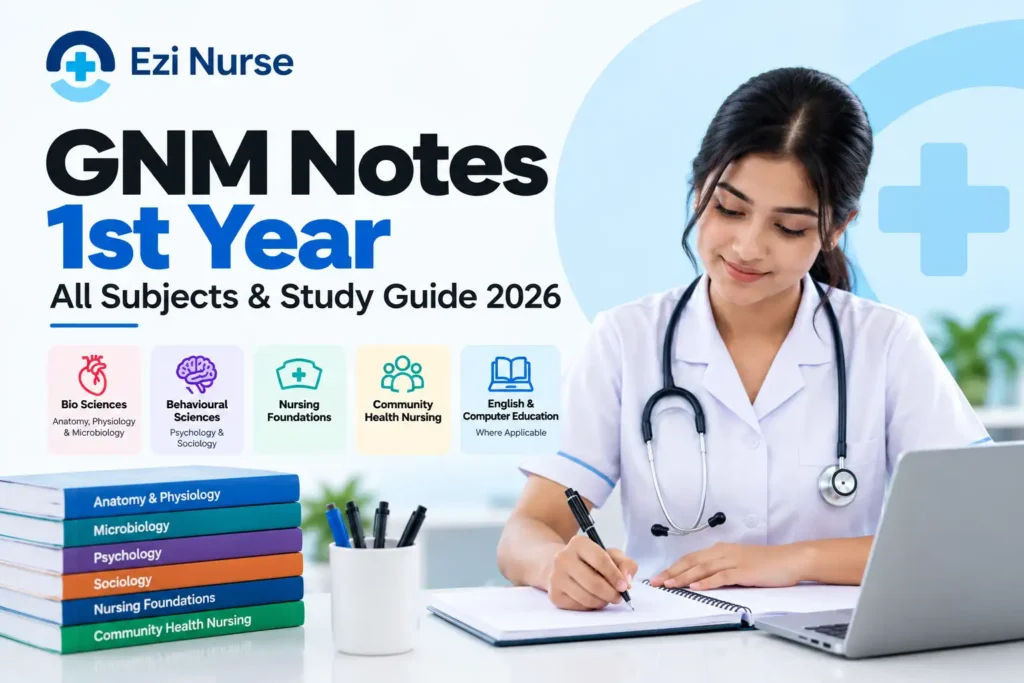
If you are beginning General Nursing and Midwifery (GNM), having clear and well-organized GNM Notes 1st Year can make a large syllabus easier to understand and revise. First-year study builds the foundation for nursing education, combining basic sciences, nursing skills, behavioural sciences, and community-focused learning.
This guide explains the main subjects and how to prepare effectively.
GNM 1st Year Subjects
GNM first-year subjects introduce students to the knowledge and skills needed for later clinical training. The exact subject structure, assessment pattern, and topic sequence can vary according to the applicable curriculum and institution, so students should check their college or relevant nursing authority for the current requirements.
Bio Sciences: Anatomy, Physiology and Microbiology
Bio Sciences introduces the structure and functioning of the human body and the basic principles of microorganisms and infection.
Important areas: Cells and tissues, skeletal and muscular systems, cardiovascular and respiratory systems, digestion, excretion, nervous and endocrine systems, reproductive health, microorganisms, immunity, infection prevention, sterilization, and disinfection.
Good GNM Notes 1st Year for Bio Sciences should use labelled diagrams, simple explanations, definitions, and flowcharts. Diagrams can also improve recall.
Behavioural Sciences: Psychology and Sociology
Psychology and Sociology help nursing students understand behaviour, relationships, families, communities, and factors that influence patient care.
Human behaviour, emotions, motivation, learning, memory, personality, intelligence, and adjustment.
Society, family, culture, social groups, communities, and social factors affecting health.
When preparing GNM Notes 1st Year for these subjects, focus on clear definitions, key concepts, short examples, and simple comparisons that make revision easier.
Nursing Foundations
Nursing Foundations introduces the principles and skills used in everyday patient care and connects classroom learning with practical responsibilities.
Important areas: Nursing principles, the nursing process, patient assessment, vital signs, personal hygiene, comfort and safety, positioning, infection prevention, medication-related responsibilities, documentation, and basic first aid.
Your GNM Notes 1st Year should be practical for this subject. Use step-by-step procedures, checklists, important precautions, and concise nursing responsibilities rather than copying long textbook paragraphs.
Community Health Nursing
Community Health Nursing introduces students to health promotion and nursing care beyond the hospital environment.
Key areas: Concepts of health and community, primary healthcare, environmental sanitation, nutrition, health education, communicable and non-communicable diseases, family health, and relevant public-health programmes.
Organize GNM Notes 1st Year around definitions, objectives, prevention measures, and the nurse's role.
How to Prepare Effective GNM Notes 1st Year
Good notes should help you find important information quickly. They do not need to copy every textbook paragraph.
Connect your notes with classroom demonstrations and clinical postings to understand why procedures are performed and how theoretical concepts are applied in patient care.
How to Study GNM 1st Year Effectively
Avoid leaving the entire syllabus until examinations. Study smaller topics regularly and revise them after class.
Use active recall by closing your notes and explaining a concept in your own words. Practise diagrams, review previous questions, and identify topics that need more attention.
Divide your weekly schedule between science-heavy subjects, nursing fundamentals, and theory-based subjects.
FAQ
The first year generally covers Bio Sciences, Behavioural Sciences, Nursing Foundations, and Community Health Nursing, with additional areas such as English or Computer Education depending on the applicable curriculum.
Organize material by subject, unit, and topic. Keep definitions, diagrams, key points, nursing responsibilities, and exam-focused questions easy to find.
Notes are useful for revision, but they should support your textbooks, classroom teaching, prescribed syllabus, previous questions, and practical preparation rather than replace them.
Use concise notes, diagrams, tables, active recall, and regular revision. Prioritize difficult topics while continuing to cover the complete syllabus.
Final Takeaway
The first year of GNM gives students the academic and practical foundation needed for future nursing education. Well-structured GNM Notes 1st Year can make revision more manageable, but effective preparation also requires understanding concepts, practising skills, and following your prescribed curriculum.
Start early, organize each subject clearly, and use GNM Notes 1st Year alongside practical learning. A consistent approach can help you enter examinations and clinical training with greater confidence.
Study Smarter with Ezi Nurse
Access nursing study materials, notes and exam preparation resources designed to help you learn better and prepare with confidence.
Download Ezi Nurse App