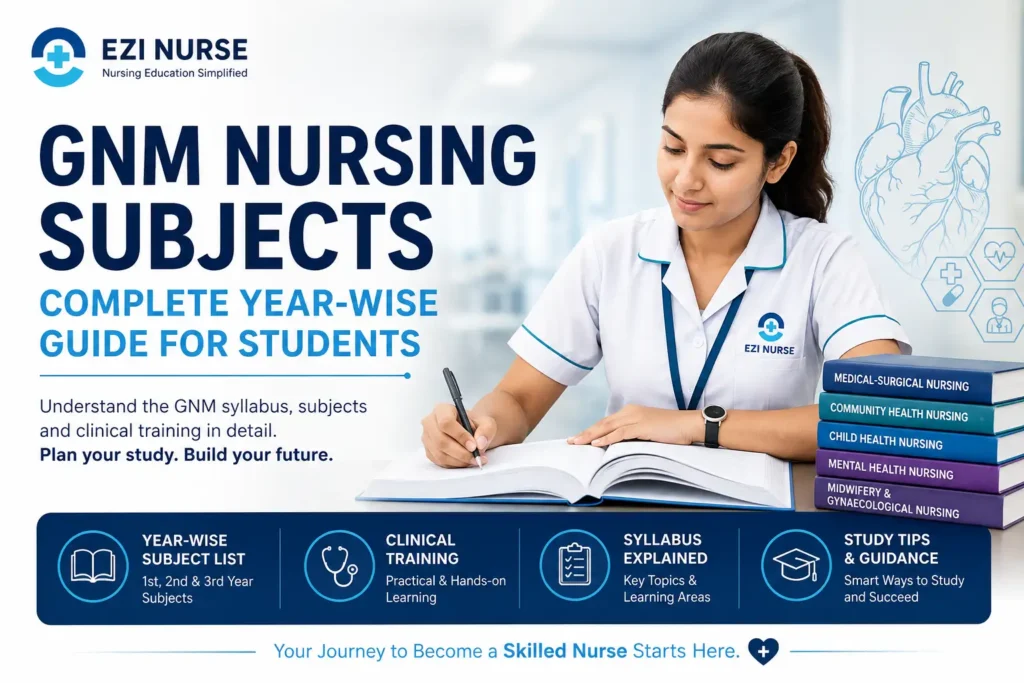
GNM Nursing Subjects: 1st, 2nd & 3rd Year Subject Guide
Understanding GNM Nursing Subjects can help students prepare for studies, examinations, and clinical training. The programme combines classroom education with practical nursing experience, progressing from foundational healthcare concepts to specialised patient care.
What Are GNM Nursing Subjects?
The GNM nursing syllabus covers foundational sciences, nursing care, community health, medical care, mental health, child health, and midwifery, gradually introducing students to specialised areas throughout the programme.
GNM 1st Year Subjects
GNM Nursing Subjects in the first year establish the foundation for nursing education and clinical practice, helping students understand the human body, basic procedures, communication, nutrition, hygiene, and community healthcare. Major areas include Anatomy and Physiology, Microbiology, Psychology, Sociology, Fundamentals of Nursing, Community Health Nursing-I, Nutrition, First Aid, Environmental Hygiene, and Health Education and Communication Skills. These GNM Nursing Subjects provide essential knowledge students can build upon in advanced nursing and clinical topics.
GNM 2nd Year Subjects
GNM Nursing Subjects in the second year introduce students to more specialised patient-care areas, helping them connect theoretical knowledge with clinical situations involving adult health, mental health, and child health. Major areas include Medical-Surgical Nursing, Mental Health Nursing, and Child Health Nursing. Medical-Surgical Nursing focuses on adult health conditions, Mental Health Nursing covers psychiatric conditions and therapeutic communication, while Child Health Nursing addresses growth, development, neonatal care, common illnesses, and immunisation.
GNM 3rd Year Subjects
GNM Nursing Subjects in the third year focus on specialised nursing practice and professional responsibilities, with greater attention to midwifery, community health, research, professional development, education, and administration. Major areas include Midwifery and Gynaecological Nursing, Community Health Nursing-II, Nursing Education, Introduction to Research and Statistics, Professional Trends and Adjustment, and Nursing Administration and Ward Management. These GNM Nursing Subjects help students develop specialised care, professional, research, leadership, and administrative skills.
Practical Training in GNM
GNM Nursing Subjects are supported by practical and clinical training, allowing students to apply classroom knowledge in real healthcare environments and develop confidence with nursing procedures under appropriate supervision. Students may receive experience in medical and surgical wards, community health settings, mental health services, paediatric care, antenatal and postnatal units, and labour rooms. Practical exposure helps connect theoretical learning with real patient-care situations.
How to Study GNM Nursing Subjects
A consistent study routine can make GNM Nursing Subjects easier to understand and remember. Students should focus on concepts rather than relying only on memorisation, while using class notes, textbooks, previous-year questions, revision materials, video lectures, and practice quizzes. Understanding Anatomy and Physiology can also make Medical-Surgical Nursing easier because students already understand how different body systems function.
FAQs
The GNM 1st year subjects commonly include Anatomy and Physiology, Microbiology, Psychology, Sociology, Fundamentals of Nursing, and Community Health Nursing-I.
The GNM 2nd year subjects mainly include Medical-Surgical Nursing, Mental Health Nursing, and Child Health Nursing.
The GNM 3rd year subjects include Midwifery and Gynaecological Nursing, Community Health Nursing-II, and professional or administrative subjects.
Conclusion
Knowing GNM Nursing Subjects in advance gives students a clearer understanding of the programme and what each academic year involves. Each stage introduces new knowledge and practical responsibilities, helping students build a stronger foundation for professional nursing. Proper planning, regular revision, and practical learning can help students approach their studies with greater confidence.