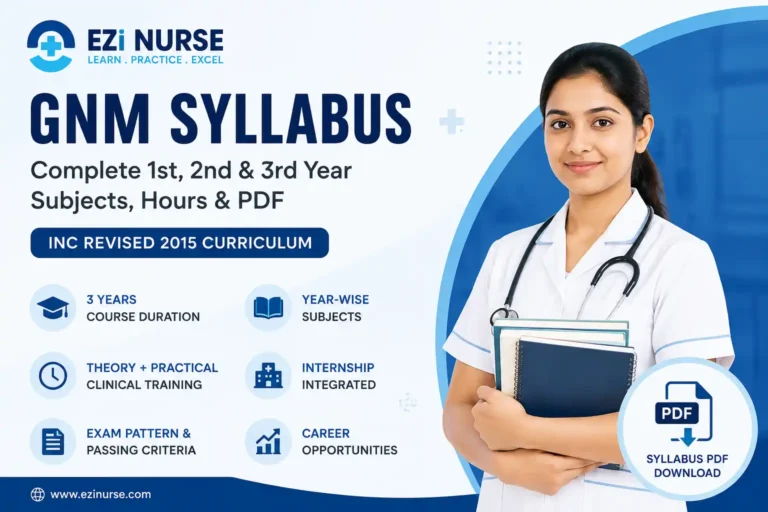
The GNM Syllabus is the academic and clinical framework followed by students pursuing General Nursing and Midwifery. For the 2026–27 academic year, students should understand that the current Indian Nursing Council (INC) reference is the revised 3-year GNM curriculum introduced from 2015–16, rather than a completely new syllabus released for 2026. INC continues to list the Revised GNM Syllabus (3 Year) among its publications. (indiannursingcouncil.org)
This guide covers the year-wise subjects, practical training, eligibility, examination structure, internship and career options to help students plan their GNM studies.
GNM Syllabus 2026–27: At a Glance
The GNM programme combines classroom learning with laboratory work, clinical experience and internship. INC lists General Nursing and Midwifery as a 3-year programme from 2015–16, with registration as R.N. & R.M. after the applicable examination and registration process.
Key points:
- Course duration: 3 years
- Curriculum: Revised GNM curriculum
- Examination: Nursing Examination Board
- Registration: R.N. & R.M.
- Learning format: Theory, practical and clinical training
- Internship: Integrated into the revised 3-year curriculum
GNM Eligibility and Admission Requirements
According to the Indian Nursing Council, candidates generally need 10+2 with English and at least 40% marks in the qualifying examination. Science is preferable. Eligible routes also include certain vocational ANM and Health Care Science qualifications, as well as registered ANMs who meet the applicable requirements.
INC’s listed age criteria are 17 years as the minimum age and 35 years as the upper age limit for GNM. Reservation provisions and other admission requirements may also apply according to applicable rules.
Students should confirm current requirements with the relevant institution and State Nursing Council before applying.
Year-Wise GNM Subjects
The GNM Syllabus progresses from nursing fundamentals to specialised clinical care and midwifery.
First Year
The first year builds the foundation required for nursing practice.
Major subjects include:- Bio Sciences
- Behavioural Sciences
- Nursing Foundations
- Community Health Nursing I
- English
- Computer Education
Nursing Foundations and Community Health Nursing introduce students to basic nursing knowledge, communication, patient-care principles and clinical skills.
Second Year
The second year focuses more strongly on medical and specialised nursing.
Major subjects include:- Medical-Surgical Nursing I
- Medical-Surgical Nursing II
- Mental Health Nursing
- Child Health Nursing
Students develop their understanding of patient assessment, disease management, nursing procedures and care for different patient groups.
Third Year
The third year focuses on maternal health, community nursing and professional preparation.
Major subjects include:- Midwifery and Gynaecological Nursing
- Community Health Nursing II
- Nursing Education
- Research and Statistics
- Professional Trends and Adjustment
- Nursing Administration
The internship component provides additional supervised clinical exposure across relevant nursing areas.
Theory, Practical and Clinical Training
A major strength of the GNM Syllabus is its combination of academic study and hands-on learning. Students develop practical competence through laboratory sessions and clinical postings rather than relying only on classroom study.
Clinical exposure may include:
- Medical-surgical wards
- Community health settings
- Child health services
- Mental health facilities
- Labour room and maternity care
- Other relevant hospital departments
The exact clinical schedule and facilities can vary by institution, so students should refer to their college’s approved training plan.
GNM Examination Pattern
Assessment includes theory examinations, practical examinations and clinical performance according to the applicable curriculum and examination board requirements.
Students should prepare for both written and practical components. Regular revision, procedure practice and clinical record maintenance can help students manage assessment requirements effectively.
The exact examination schedule, internal assessment process and passing requirements should be confirmed with the relevant Nursing Examination Board or institution because implementation details can vary.
GNM Internship
Internship is an important part of the revised three-year programme. INC states that the duration of GNM was reduced from 3½ years to 3 years from the 2015–16 academic year, with internship integrated into the revised syllabus.
During internship, students gain supervised experience and apply theoretical knowledge to real clinical situations. This period can also help students identify areas in which they want to develop further after graduation.
Career Options After GNM
The GNM Syllabus prepares students for professional nursing practice and provides a foundation for further education.
After completing GNM and meeting applicable registration requirements, graduates can explore opportunities such as:
- Staff Nurse
- Nursing Officer recruitment
- Community healthcare roles
- Hospital nursing
- Private healthcare organisations
- Post Basic B.Sc. Nursing
- Further nursing specialisations
Career opportunities and eligibility for specific posts depend on registration status, employer requirements and applicable government or state regulations.
How to Prepare for GNM
Conclusion
The GNM Syllabus for the 2026–27 academic year should be understood in the context of the INC revised 3-year curriculum. It combines nursing theory, practical education, clinical exposure and internship to prepare students for professional nursing practice. Students should use the syllabus as a study roadmap while confirming admission, examination and registration requirements with their institution and the relevant nursing authorities.
FAQs
Yes. INC lists GNM as a 3-year programme from the 2015–16 academic year and continues to list the Revised GNM Syllabus (3 Year).
The GNM Syllabus includes Nursing Foundations, Community Health Nursing, Medical-Surgical Nursing, Mental Health Nursing, Child Health Nursing, Midwifery and Gynaecological Nursing, along with supporting subjects, practical training and internship.
INC’s current eligibility information states that candidates generally need 10+2 with English and at least 40% marks. Science is preferable, while certain vocational and registered ANM routes are also eligible. The listed age range is 17 to 35 years.
Prepare for Your Nursing Career
Planning for Nursing Jobs Abroad starts with strong nursing knowledge and consistent preparation. Ezi Nurse provides nursing-focused learning and exam preparation resources to help students and aspirants build their knowledge and prepare for their career goals.
Start Learning with Ezi Nurse