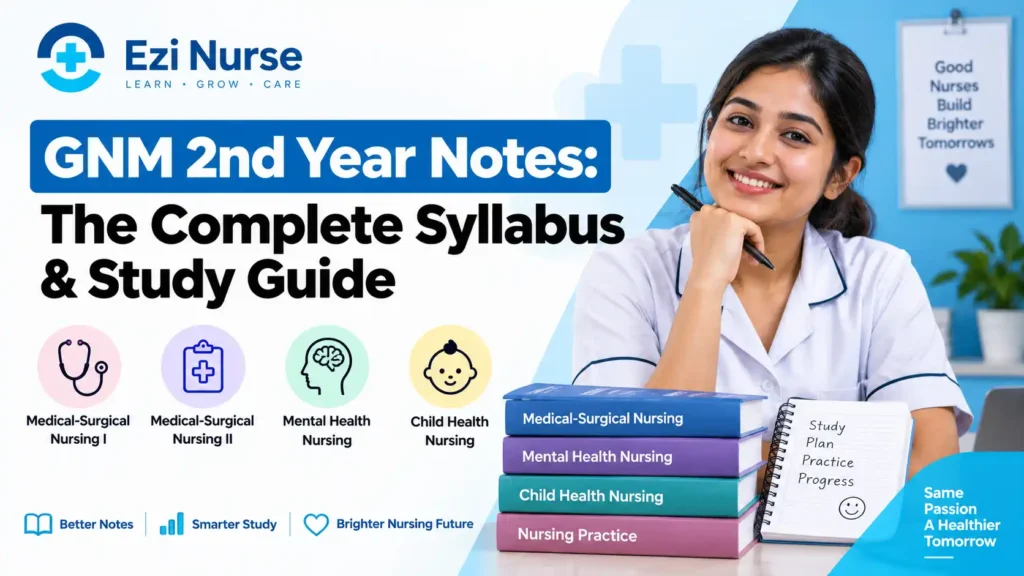
GNM 2nd year is an important stage of the General Nursing and Midwifery programme. The curriculum moves deeper into medical-surgical, mental health, and child nursing, making organised study more important. Good GNM 2nd Year Notes can help students understand large topics, revise important concepts, and connect classroom learning with clinical practice.
This guide covers the main second-year subjects, important topic areas, practical preparation, and a simple study strategy.
GNM 2nd Year Subjects
The second year generally covers four core subjects:
- Medical-Surgical Nursing I
- Medical-Surgical Nursing II
- Mental Health Nursing
- Child Health Nursing
Students should use their prescribed curriculum, college guidance, and applicable State Nursing Council requirements as the final reference for subject units, examination schemes, and practical requirements.
| Subject | Main Focus |
|---|---|
| Medical-Surgical Nursing I | Adult medical and surgical conditions and nursing care |
| Medical-Surgical Nursing II | Additional speciality and advanced clinical care |
| Mental Health Nursing | Mental health conditions and psychiatric nursing |
| Child Health Nursing | Newborn, child, and adolescent nursing care |
1. Medical-Surgical Nursing I
Medical-Surgical Nursing forms a major part of second-year study. It focuses on assessment, treatment support, and nursing care for adults with different medical and surgical conditions.
Important areas include:
- Nursing process and patient assessment
- Respiratory disorders
- Cardiovascular disorders
- Gastrointestinal disorders
- Genitourinary disorders
- Pre-operative and post-operative nursing care
- Infection prevention and patient safety
When preparing GNM 2nd Year Notes for this subject, organise disease-based topics under simple headings such as definition, causes, signs and symptoms, investigations, treatment, nursing management, complications, and patient education. This format makes lengthy topics easier to revise.
2. Medical-Surgical Nursing II
Medical-Surgical Nursing II expands clinical knowledge and introduces additional speciality areas.
Key areas may include:
- Neurological disorders
- Endocrine disorders
- Musculoskeletal conditions
- Oncology nursing
- Eye, ear, nose and throat conditions
- Emergency and disaster nursing
Rather than trying to memorise every detail, focus on what a nurse needs to assess, monitor, report, and manage. Flowcharts, condition-wise tables, and concise GNM 2nd Year Notes can also make complicated topics easier to understand and recall.
3. Mental Health Nursing
Mental Health Nursing focuses on understanding mental health conditions and providing safe, therapeutic, and compassionate nursing care.
Important topics include:
- Concepts of mental health and mental illness
- Therapeutic communication
- Psychiatric assessment
- Schizophrenia
- Mood disorders
- Anxiety-related conditions
- Substance use disorders
- Psychiatric emergencies
- Psychotropic medications and nursing responsibilities
Your GNM 2nd Year Notes should clearly separate symptoms, nursing assessment, interventions, safety measures, and patient or family education. Therapeutic communication is particularly important because it connects theoretical knowledge with real patient interaction.
4. Child Health Nursing
Child Health Nursing focuses on the physical, emotional, and developmental needs of infants, children, and adolescents.
Major areas include:
- Growth and development
- Newborn care
- Paediatric assessment
- Immunisation
- Child nutrition
- Common childhood illnesses
- Care of hospitalised children
- Selected neonatal and paediatric conditions
- IMNCI concepts
Age-wise developmental charts, immunisation information, nursing care plans, and concise disease summaries can make revision more manageable.
How to Prepare Effective GNM 2nd Year Notes
The best notes are not necessarily the longest. They should make important information easier to understand and retrieve during revision.
For disease-based topics, follow a consistent format:
- Definition
- Causes or risk factors
- Signs and symptoms
- Investigations
- Medical management
- Nursing management
- Complications
- Patient education
For practical subjects, maintain separate records for procedures, case studies, clinical observations, and skills learned during postings. Connecting practical experience with theory can improve understanding and make revision more meaningful.
Important Topics for Exam Preparation
Students should prioritise important concepts while continuing to cover the complete syllabus. Useful revision areas include:
- Nursing process and nursing care plans
- Major medical and surgical disorders
- Emergency nursing principles
- Therapeutic communication
- Common psychiatric disorders
- Growth and development milestones
- Newborn and paediatric care
- Immunisation and child nutrition
- Nursing responsibilities related to commonly used medications
Use GNM 2nd Year Notes alongside previous-year question papers to understand question patterns and practise writing structured answers. Notes should support preparation rather than replace complete syllabus coverage.
A Simple Study Strategy
A weekly study schedule can help students give every subject regular attention. Study difficult medical-surgical topics when concentration is highest, and use shorter revision sessions for definitions, classifications, and charts.
After completing a topic, test yourself without looking at your notes. Try explaining the condition, nursing care, and important precautions in your own words. Active recall can be more useful than repeatedly reading the same pages.
Keep your study material updated as teachers introduce additional topics, practical procedures, or institution-specific examination requirements.
Final Takeaway
Second year becomes easier when students move beyond memorisation and understand how nursing knowledge is applied to real patients. Use structured GNM 2nd Year Notes as a revision tool, while continuing to refer to prescribed textbooks, classroom teaching, clinical guidance, and the applicable nursing curriculum.
A consistent study routine, regular practical practice, and focused revision can help students approach examinations and clinical postings with greater confidence.
FAQs
The main subjects are Medical-Surgical Nursing I, Medical-Surgical Nursing II, Mental Health Nursing, and Child Health Nursing.
Yes. Clinical postings and practical learning are important parts of nursing education. Students should understand procedures, patient care, documentation, communication, and safety rather than preparing only for written examinations.
Divide the syllabus into smaller topics, create concise subject-wise notes, practise previous-year questions, revise regularly, and connect theory with clinical experience. Focus especially on nursing management and patient-care priorities.
Make Your Nursing Studies Easier
Build better study habits, strengthen your nursing knowledge, and prepare with the right learning support. Explore Ezi Nurse and take your nursing studies a step further.
Start Learning with Ezi Nurse